


Get Free Ebook The One-Minute Workout: Science Shows a Way to Get Fit That's Smarter, Faster, Shorter, by Martin Gibala
Reviewing, exactly what do you think about this word? Is this word burdening you? With many works, responsibilities, as well as activities, are you compelled a lot to do this specific task? Well, also many people think about that reading is kind of monotonous activity, it does not indicate that you must ignore it. Occasionally, you will certainly require times to spend to review guide. Also it's simply a publication; it can be a really worthwhile and priceless point to have.
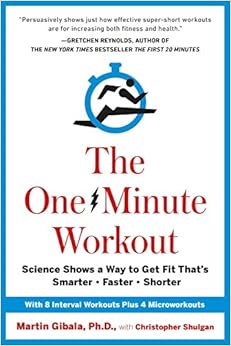
The One-Minute Workout: Science Shows a Way to Get Fit That's Smarter, Faster, Shorter, by Martin Gibala

Get Free Ebook The One-Minute Workout: Science Shows a Way to Get Fit That's Smarter, Faster, Shorter, by Martin Gibala
Discover the secret to improve the lifestyle by reading this The One-Minute Workout: Science Shows A Way To Get Fit That's Smarter, Faster, Shorter, By Martin Gibala This is a kind of publication that you require now. Besides, it can be your favorite publication to review after having this book The One-Minute Workout: Science Shows A Way To Get Fit That's Smarter, Faster, Shorter, By Martin Gibala Do you ask why? Well, The One-Minute Workout: Science Shows A Way To Get Fit That's Smarter, Faster, Shorter, By Martin Gibala is a book that has various unique with others. You might not need to know who the author is, exactly how widely known the work is. As wise word, never judge the words from who speaks, yet make the words as your good value to your life.
Nonetheless, absolutely nothing is difficult in this life. You could obtain exactly what you truly believe intend to do as well as obtain for something brand-new. Nevertheless, the assumption of having great behavior will have lots of challenges. But, to get rid of the issue, we offer you a reference to start loving reading.
By seeing this page, you have actually done the right looking factor. This is your begin to select guide The One-Minute Workout: Science Shows A Way To Get Fit That's Smarter, Faster, Shorter, By Martin Gibala that you want. There are bunches of referred books to read. When you would like to get this The One-Minute Workout: Science Shows A Way To Get Fit That's Smarter, Faster, Shorter, By Martin Gibala as your e-book reading, you could click the web link web page to download The One-Minute Workout: Science Shows A Way To Get Fit That's Smarter, Faster, Shorter, By Martin Gibala In couple of time, you have possessed your referred books as your own.
After getting this publication, it will be much better for you to read it asap. This book will certainly connect the description as well as reasons of why this book is most wanted. It will be the ways you get the new capacity and also abilities to be far better. Naturally it will help you to face the problems of deadline works. The One-Minute Workout: Science Shows A Way To Get Fit That's Smarter, Faster, Shorter, By Martin Gibala is very significant to do as well as get, so what sort of book content that you require now? Find them in the checklists of this website.
About the Author
Martin Gibala, Ph.D., is a professor and chair of the kinesiology department at McMaster University in Hamilton, Ontario. His research on the physiological and health benefits of high-intensity interval training has attracted immense scientific attention and worldwide media coverage. Gibala has published more than 100 peer-reviewed articles, the results of which have been featured by outlets including The New York Times, The Wall Street Journal, Vox, CNN, NBC Nightly News, and Conan. He is frequently invited to speak at international scientific meetings and has received multiple awards for teaching excellence. Christopher Shulgan is an author who specializes in collaborating with fascinating figures who have something important to say. He lives in Toronto.
Read more
Excerpt. © Reprinted by permission. All rights reserved.
Chapter One Fit in Just Minutes a Week?Feel like you don’t have time to exercise? Looking for a way to get in shape—fast? Of course you are. Regular physical activity makes you look and feel better. You’ll also fight the aging process, go through your days in happier spirits, and reduce your chance of developing ailments like cardiovascular disease, diabetes, and even cancer.I think exercise is one of the best things around. Most of us are under the impression, however, that exercise has to be time-intensive. We have this notion that it takes at least an hour to get in a good workout—more if you factor in the time required to get to and from the gym.My studies show that idea is nonsense. The past decade has seen an explosion of research into the science of high-intensity interval training, better known by its acronym, HIIT, pronounced “hit.” We’re learning that HIIT can provide serious benefits that increase a workout’s time-efficiency. Sprint interval training, or SIT, which is the most extreme version of the technique and is characterized by a few brief bursts of all-out exercise, is especially potent. We’re not just talking running here. HIIT techniques can be applied to virtually any mode of traditional cardio-type exercises, such as cycling, swimming, or rowing. Thanks to the new science of ultra-low-dose exercise, those who read this book will learn strategies to get fit in the time required to grab a coffee, update a Facebook status, or check a Twitter feed.Think for a moment about the traditional concept of what it takes to get fit. Most of us will envision an activity that requires hours and hours of hard work. Lots of miles pedaling in the bike saddle. Entire afternoons navigating running trails. Lap after lap at the local pool. Consequently, many people are too intimidated to even try to get fit. Many of us feel like there simply isn’t enough time to fit in a workout.But you know what? That’s wrong. That’s what my years of study have taught me. I’ve discovered that fitness is possible without spending countless hours in the gym. I don’t want to say that all the people who do that are wasting their time. But the fact is, a method exists that enables you to reap the benefits of hours of exercise in just minutes per day. Strategies can be incorporated to transform you from out of shape to fit in the least amount of time possible. Among my biggest discoveries is a workout that provides the benefits of nearly an hour of steady aerobic exercise with just a single minute of hard exercising.Pretty remarkable, right?This book is for the people who believe they don’t have time to exercise. In these pages, I describe techniques pulled from the latest scientific studies—how they work and how you can use them. I also provide tips on how to best manage your weight. And provide some easy methods to design muscle-building workouts that can be conducted anywhere from hotel rooms to your local park, with little or no need for special equipment.I know, I know—many personal trainers and workout celebrities promise such benefits. But they don’t have the deep scientific knowledge that comes from being a leading researcher in the field. The groundbreaking studies that have come out of my lab have been covered by the New York Times, Time magazine, and NBC Nightly News, to name just a few media outlets. In 2015, a review article that I wrote on the topic of time-efficient exercise was the most accessed paper in the Journal of Physiology, the world’s most cited physiology journal. In fact, the top two titles on the Journal’s annual ranking of most-accessed papers were from my laboratory, and we had three in the top fifteen. That’s quite a feat, considering all the amazing human physiology research that is conducted worldwide.I am also fortunate to work with a lot of great people. As the chair of the Department of Kinesiology at McMaster University in Hamilton, Canada, I interact on a daily basis with people whose assembly of brainpower ranks among the best on the planet. “McMaster is one of the centers of the universe when it comes to exercise,” observes Carl Foster, a physiologist at the University of Wisconsin–La Crosse and a past president of the American College of Sports Medicine. In fact, McMaster is a world-leading center of excellence in the study of how physical activity changes human physiology and health.With this book, I’ve drawn on the expertise of past and present McMaster minds and some of the smartest exercise physiologists in the world to create the most definitive guide to time-efficient exercise. I hope you’ll also find it’s an entertaining read. Once you’ve finished it, you’ll know enough to design your own time-efficient workouts. And you’ll have grasped the techniques required to go from out of shape to a buff portrait of health in the least amount of time.Already fit? If you’re not using the techniques described here, chances are you’re getting beat by someone who is. This book will provide you with techniques that can help you break through a training plateau and drop seconds or even minutes from your personal-best times. It’ll also allow you more time to do other stuff, like work or hang out with loved ones, because you’re not spending hours in the saddle, on the trails, or in the pool. And during those weeks or months when work or other duties make it difficult to exercise, this book will provide you with a series of techniques designed to maintain your fitness level in the minimum amount of time.So let’s get to discussing the most time-efficient workouts possible, for everyone from couch potatoes looking to get in shape to athletes wanting to boost their race performance. No longer do you have to fit your day around your workout. Now you can fit working out around your day.Introducing a More Time-Efficient Way to Work OutSo what is interval training? Basically, it’s bursts of intense exercise separated by periods of recovery, which can involve complete rest or lower-intensity exercise. Understanding the concept is easier if you contrast it with regular endurance training. That’s the sort of thing most people envision when they think about heading out for a run. Or head out for a swim. Or a ride. The point is that traditional exercise training involves traveling a certain distance at a relatively constant pace. The resultant graph of effort versus time looks roughly like this:That line of constant effort might stretch out to forty-five minutes, an hour, ninety minutes, or even more. When you can afford the time, it’s wonderful to get out and just run or ride with your mind at ease. That sort of training has a lot of therapeutic benefits. It reduces stress and can provide the opportunity to enjoy the outdoors. But my research has shown that it is anything but the most efficient way to train.If time is our most valuable resource, and if we’re attempting to get the most benefit from exercise in the least amount of time, then, as my research has shown, we’re better off employing interval-training techniques. The graph of an interval-training workout looks more like this:The idea is to vary the intensity of your workout. Go hard, relax, go hard, relax. The harder you go, the shorter the duration and the fewer intervals you need to achieve the same benefits of a much longer endurance-training workout.People have been trying for centuries to get the benefits of exercise in creative ways that require less time. Think about hucksters wandering the Wild West promoting health elixirs or comic-book classified ads promising strongman muscles in mere weeks. More recently, the prestigious academic journal Cell published a study about a compound, known by the acronym AICAR, that helped sedentary mice run for 44 percent farther than untreated mice. The study raised a flurry of excitement about the possibility of developing an exercise pill, yet no one’s been able to replicate the results in humans.Interval training is the closest thing we have to an exercise pill. And over the past ten years there’s been an explosion of research into the technique. This research has been conducted in my own lab as well as those of my colleagues all over the globe. And researchers like myself have concluded that high-intensity interval training may be the most efficient workout that the science of physiology has ever produced. Neatly summing up its benefits, A.J. Jacobs wrote in Esquire, “HIIT could be the biggest time-saver since microwaves.”HIIT is so popular that it has ranked at or near the top of the annual list of worldwide fitness trends compiled by the American College of Sports Medicine, the largest sports medicine and exercise science organization in the world. Personal trainers everywhere from New York to Hong Kong are staging fitness classes based on principles I helped establish at McMaster, just as Hollywood stars and Victoria’s Secret models are using HIIT principles to get ripped for movie roles and fashion-week runway appearances. But here’s the thing: We’ve still got this idea in our heads that interval training is reserved for incredibly fit people working out in gyms in incredibly tight clothing. And doing workouts that last about an hour.Again, that’s nonsense. Workouts don’t have to last an hour. They can last ten minutes or even less—and get you remarkable fitness benefits in that time. Even if you’re overweight. Even if you’re out of shape. There is a “flavor” of interval training appropriate for you. This exciting new science of interval exercise can be adopted to help everyone get fit—especially the people who long ago wrote off exercise because they felt like they didn’t have the time.Want to get fit fast? Or just get up a flight of stairs without losing your breath? Interval training can help. Want to cut your Ironman time? Burn fat faster? Or simply increase how far you can pedal on your Sunday ride? Interval training can help with that, too.Most important, it can help in a lot less time than you ever thought possible. Interval training is perfect especially for the most time-pressed among us—everyone from city-hopping frequent-flyer executives to stay-at-home parents.Public health guidelines generally call for at least two and a half hours per week of moderate-intensity exercise to gain health benefits. Devoted fitness enthusiasts often schedule at least an hour per workout. Interval training is a way to get the benefits of an hour-long run or bike ride in a fraction of the time. In the most extreme form, known as sprint interval training, it’s possible to get those same benefits with just three minutes of hard exercise a week. In fact, my lab conducted the study that showed this—and the resultant news story rocketed to the top of the New York Times’ most-popular-articles list.I’m excited about this book for the same reason I’m excited about interval training itself—for their potential to make the benefits of exercise available to the greatest possible number of people. To that end I’ve tried to make this book a compelling instruction manual that’s written in plain language and understandable for those without a degree in physiology.I tell readers what interval training is, why and how it works, and who it works for. Then I provide a series of workouts and microworkouts that have been tested in laboratories around the world, followed by a discussion of the workouts’ benefits, which have been established through rigorous scientific study.The technique can be applied to pretty much any sort of exercise—and the most time-efficient versions include elements that boost both cardiovascular fitness and strength. Cycling, swimming, or bodyweight-style movements like burpees, push-ups, and pull-ups—they all accommodate interval-training techniques.Now, I’m excited to translate the latest science into training techniques that virtually anyone can use.How I Got HIITThese days, when I conduct interviews on television shows or in newspapers, the journalists call me things like the “guru” of interval training. This makes me a bit uncomfortable, especially given the training method’s incredible history (which we’ll consider in chapter three). It’s true that I’ve devoted most of my career to researching the topic. I’ve published dozens of academic studies in peer-reviewed journals over the past decade involving every aspect of interval training—how to do it, who can benefit, and how its potency compares with that of more traditional exercise approaches.Looking back to the beginning of my research, I can see why I started pursuing it when I did. In 2004 I had just begun my all-important second three-year contract as an assistant professor at McMaster University. Tenure is a tough thing to secure in academia, and I had less than thirty-six months to prove myself as an asset to the university—or be jettisoned from the faculty. It was my career’s ultimate make-or-break period.On top of the pressure to produce quality research, I was teaching three courses, including one to more than two hundred undergraduates. My wife, Lisa, had just gone back to work as a high school physical education teacher. We had two young boys, ages one and three. Juggling my child-rearing responsibilities with teaching and research meant that, for the first time in my life, I felt like I didn’t have time to exercise.I can remember coming home from my office hours and walking through my front door excited at the possibility of trying to squeeze in a workout. But then something would come up. The boys would need to be fed. Or we’d be out of milk. Somebody might have a fever. I’d put off exercising to cater to more pressing needs. It would be days or even a week before another chance to exercise would emerge.Interval training at that point was largely confined to the domain of highly trained individuals focusing on athletic performance. Few regular people ever performed interval-based workouts. Explaining why the average person didn’t appreciate the value of intervals requires learning a bit about the way the body works.Fitness means different things to different people. To exercise scientists, it means cardiorespiratory fitness, a parameter that can be measured in the laboratory by way of a test called maximal oxygen uptake or “VO2max” (the “V” stands for “volume”). It is also called aerobic fitness, and it refers to the capacity of your body to transport and utilize oxygen. Scientists have found that it’s one of the best predictors of overall health. The more aerobically fit you are, the better your heart can pump blood, the longer it takes you to get out of breath, and the farther and faster you’re able to bike or run or swim. One more thing: It also happens to be the form of fitness that helps you live longer and live better by reducing your chances of developing ailments like cardiovascular disease and diabetes. Aerobic fitness is the thing most of us want when we first start working out.
Read more
Product details
Hardcover: 272 pages
Publisher: Avery; 1 edition (February 7, 2017)
Language: English
ISBN-10: 9780399183669
ISBN-13: 978-0399183669
ASIN: 0399183663
Product Dimensions:
6.3 x 0.9 x 9.3 inches
Shipping Weight: 1.2 pounds (View shipping rates and policies)
Average Customer Review:
4.4 out of 5 stars
91 customer reviews
Amazon Best Sellers Rank:
#97,959 in Books (See Top 100 in Books)
Before you read this you're thinking "one minute workout? Yeah right" and that's where the trouble starts. This book is about efficient exercise in as little time but it comes off as fadish. There are no one-minute exercises in this book, all workouts are 10-30mins long. This is a well-researched book by a respected authority on the subject of exercise and this book represents the benefits of HIIT (High intensity interval training).His stated goal is to make exercise available for everybody by making it easy and time I wish he had the same goals for this book as well.For example, this book doesn't explain what's the difference between aerobic and anaerobic exercise and jumps into which exercise uses which modeHe also has a confusing array of exercises and given the options you end up wondering where should you start or do.Even in exercise details, he starts with background and an image of what the interval looks like but near the end of each exercise he tells you who should do this and that's when you realize its core people above 60 or power athletes etc. this section should be first so you can understand if you need to read this or not. Even better it should just recommend what exercise you should follow if you're getting started and your or in an older demographic, or have access to a gym or if you're an athletes etc.The book makes the same point multiple times trying to prove again an again that HIIT works and gets very repetitive after the 5th study. We're sold on the book, what we need is to hear a simple "this is what I mean by efficient exercise and this is what we need to do" and we'll do it and the results is the proof that matters.My recommendation is to go through the exercises in this book, select one that suits you, you're probably well off skipping everything else.
This book inspired me to change up my exercise routine and for the first time in 17 years my blood sugar dropped to 95 from 115. This was important to me because on my paternalside almost all the males develop type 2 diabetes as they age (I fast approaching 70). I have been exercising and avoiding sugar to prevent becoming pre-diabetic. While successfully holding off diabetes , I have never gotten back to a sugar level considered healthy. Now I have. Personally I find that understanding the science behind a claim makes a program more compelling. His results have also been verified by other scientists. So there is real science buried in this book. His explanation of how your body can reprogram your genetic response only takes about 3 pages. My only complaint is that the book is written for the general public and the science gets a bit lost among the personal stories. The detailed discussion of the various HIIT programs gives a range of workouts for everyone from an advanced athlete to an old guy like me to a cardiac attack survivor. I believe that for us normal seniors, the chapter on the micro exercises is the one with the biggest payoff. I highly recommend this to anyone who considers their health to be their real wealth.
"I Will Never Be Too Big To Look Up To You."On the cusp of turning 50 I was feeling my age despite having just run 18:55 for 5K, not too shabby for an older guy. Thirty miles a week of mostly long slow distance left me fatigued to the point of irritability, a disinterest in running, and low grade upper respiratory issues that hung around like one of those tenacious northeast winters. With small kids to attend to I needed a radical change in my workout regimen. Intuitively I moved to HIIT in a slow and progressive manner and rediscovered a fountain of youthful energy, and athleticism in my 50's and 60's.Now Dr. Martin Gibala offers us the science behind how to do less exercise, enjoy it more, and experience a level of wellness unparalleled. Raised in a Jewish family that was not religious, I was never one to sit in a pew and be moved to shout Amen! Well, Dr. Gibala here is a well deserved Amen!!!! from an ardent and devoted choir member. I am convinced that as a result of HIIT(Hight Intensity Interval Training), I found the energy, determination, focus, and resilience from stress to graduate as a psychoanalyst, release my first CD, and publish my memoir.I will tell you readers that in the middle of reading this book I so gushed with enthusiasm that I turned to my wife and chewed her ear off. For years I had been singing the praises of HIIT. Most people looked at me with a vacant and disinterested stare Here was a respected exercise physiologist, a leader in his field writing as if to me me and telling me I was not crazy to believe that I had put the aging process in s choke hold.Thank you Dr. Gibala for your landmark book!Regards,Mitchell Milch, LCSWPsychotherapist & Author of "Do I Still Need My Head Examined Or Just A New Pair Of Running Shoes?"
This book's title is not to be taken too seriously. It's about doing high intensity exercise to do more efficient workouts. Whilst one could do a one minute workout (not including warm up or cool down) it's more about trying to make the most of the your gym time. I know the author wanted a punchy title but I wish it was something a little less appealing to the masses.
Wish I’d read the reviews before buying this. As a previous reviewer mentioned, the title is very misleading. All workouts are 25 to 30 minutes.Think this is more for the seasoned athlete than the average person who’s just trying to stay reasonably fit.
This was an awesome read. As a sports performance and adult fitness coach I loved the research and detailed explanations about what makes interval training so effective. I've been incorporating more of this into my own training as well as my clients and the efficiency of it allows for a lot more to be accomplished in little time.
The One-Minute Workout: Science Shows a Way to Get Fit That's Smarter, Faster, Shorter, by Martin Gibala PDF
The One-Minute Workout: Science Shows a Way to Get Fit That's Smarter, Faster, Shorter, by Martin Gibala EPub
The One-Minute Workout: Science Shows a Way to Get Fit That's Smarter, Faster, Shorter, by Martin Gibala Doc
The One-Minute Workout: Science Shows a Way to Get Fit That's Smarter, Faster, Shorter, by Martin Gibala iBooks
The One-Minute Workout: Science Shows a Way to Get Fit That's Smarter, Faster, Shorter, by Martin Gibala rtf
The One-Minute Workout: Science Shows a Way to Get Fit That's Smarter, Faster, Shorter, by Martin Gibala Mobipocket
The One-Minute Workout: Science Shows a Way to Get Fit That's Smarter, Faster, Shorter, by Martin Gibala Kindle

0 comments:
Post a Comment